
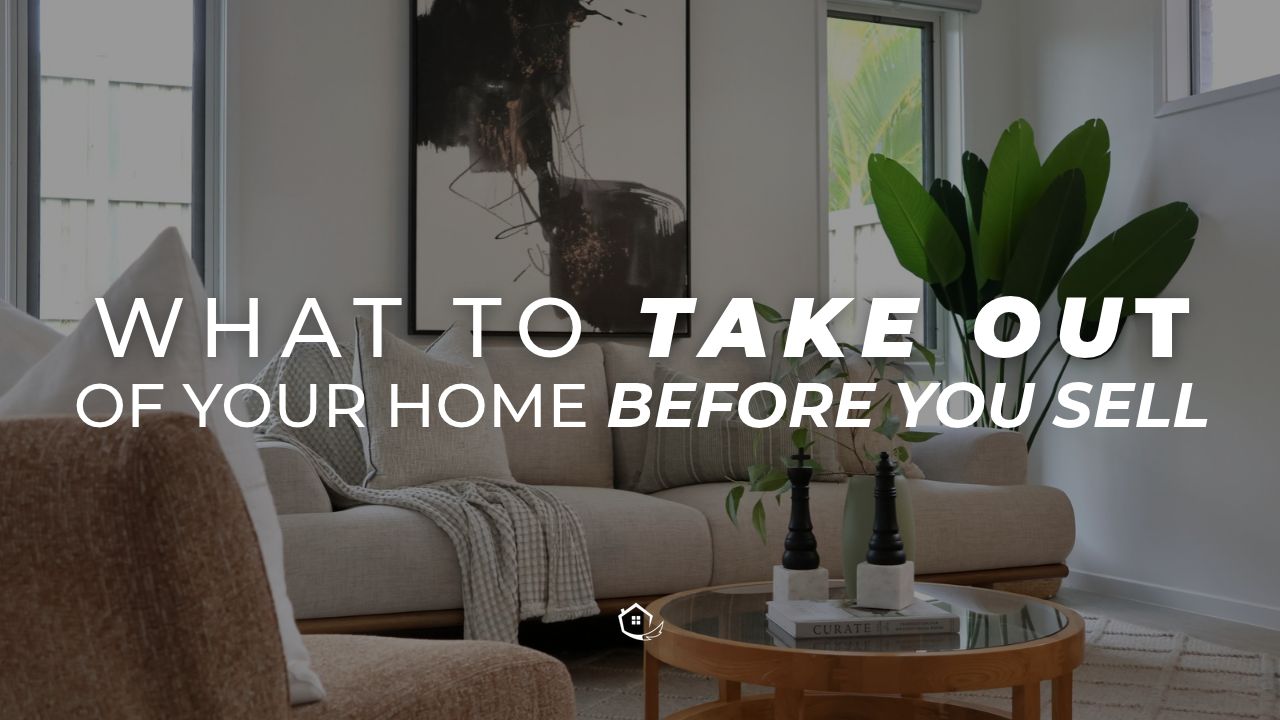
What to take out of your home before you sell
“What should I take out of the house before the photos?”
Take out anything that’s about you rather than the home, and anything that hides how a room works. For most homes that means personal photos and certificates, extra TVs, oversized furniture pushed against walls and windows, anything blocking a wardrobe or doorway, and most of what’s sitting on your benches and shelves.
The goal isn’t an empty house. It’s a home a buyer can walk through and picture their own life in.
We’ve styled more than 8,000 homes across Brisbane and the Gold Coast, and plenty of them still had the owners living in them. These are the things Phoebe, co-founder of Foxy Home Staging, asks sellers to take out first.
Why does decluttering matter when you sell?
Over years in a home, everyone collects things. Every piece tells a story, and that’s what makes it yours. When you sell, the job changes. It stops being about how you’ve lived in the home and starts being about how the next owner will.
Buyers see your home on a phone first. A photo with a lot going on gives the eye nowhere to settle, and anything that shows off your life takes attention away from the space. Then at the open home, they’re working out where their sofa goes, which room is the kids’ and whether the second living area is big enough. Clutter makes those answers harder to see.
Personal photos, certificates and mementos
This is the one agents raise most, and it’s at the top of Phoebe’s list too. Wedding photos, school photos, family portraits and keepsakes are unique to you. They tell your story, and buyers need room to imagine theirs.
Buyers notice more than most sellers expect. A wall of family photos or certificates pulls their attention onto you and off the room they’re standing in.
Pack away:
- Family and wedding photos
- Certificates, awards and school photos
- Kids’ artwork and notes on the fridge
- Collections and souvenirs that point to your own interests
Furniture arranged around the TV
Most family homes are set up around the television, and for living in them, that makes sense. For selling, it causes problems:
- Sofas get pushed against walls so everyone faces the screen.
- Furniture sits in front of windows and blocks the light.
- The room gets cut in half, with everything on one side facing the TV.
Big, comfortable family lounges are great for real life and forgiving with kids. They usually aren’t the pieces that make a room look its biggest. If you’re styling with your own furniture still in the home, these are often the first pieces a stylist will suggest storing, because taking them out opens the room up and lets the natural light back in.
Extra TVs
If you’ve got more than one living area, think about how many of them need a TV. Not every buyer wants a screen in every room.
A second or third living space often presents better with a sideboard or console where the TV was, so it can read as a kids’ retreat, a work-from-home space or a quiet sitting room.
Anything blocking a wardrobe, window or doorway
If a buyer can’t open a built-in wardrobe, they can’t see it, and a room that hides its storage feels smaller and less useful than it is.
It comes up often in kids’ and teenagers’ bedrooms: a desk in front of the robe, or beds pushed hard against the wall to make floor space for play. Clear the wardrobe doors, windows and walkways. For selling, beds also present better centred on the wall with space on both sides.
Too much on the benches and shelves
Small spaces show this fastest. A big spread on a small dining table, another on the kitchen bench and a third on the display behind it, and a unit starts to feel cramped even with all the right furniture in it. Phoebe’s fix is to take things away, not add more.
Clear the kitchen bench back to a few pieces. On consoles and sideboards, you don’t need something on both ends. Styling one side can still feel balanced.
Pieces that don’t belong together
Furniture collected over the years often ends up as a mix: one room from your first home, another from a hand-me-down set. That’s normal. For buyers, it can make each room feel like a different house.
Where you can, group the pieces that suit each other and store the ones that don’t. When everything feels like it belongs, there are fewer question marks as buyers walk through.
Out the front
Decluttering doesn’t stop at the front door. Overgrown hedges and trees can block light into the home, even when they feel like privacy. Phoebe’s advice is to cut them back. Curtains give you privacy inside, and buyers only see the lost light. Make sure the house number is easy to find too.
What shouldn’t you take out?
It’s possible to go too far. Decluttering isn’t emptying, and a home with too little in it raises its own questions. Will my home sell for less if it’s vacant?
- Leave beds in the bedrooms. A spare bedroom set up as a study gets read as a study, and the home can end up priced like it has one fewer bedroom. A single bed is better than none.
- Keep the furniture that shows how each space is used, like a dining setting and a sofa in each living area.
- Keep a few soft layers. Rugs, linen and cushions help a room photograph well.
Where does it all go?
Into storage, the garage or a friend’s place for the length of the campaign. You don’t need to pack your whole life away, only the things that get in the buyer’s way.
If you’re not sure what should stay and what should go, ask a stager to walk through with you. Most will give you a list of what to store and what to keep, and some can work with your furniture and fill the gaps, so you don’t have to empty the home. At Foxy, that’s called integrated styling, and it’s a big part of what we do.
The short version
Take out what’s about you and what blocks the room: personal photos, certificates, extra TVs, furniture against windows, anything in front of a wardrobe, and most of what’s on the benches. Leave the beds, the dining setting and the pieces that show how each room works.
If you’d like a stylist to walk through your home and tell you what to keep and what to store, book a complimentary consultation. You’ll have a plan and a full quote back within 24 business hours.


Facebook Comments