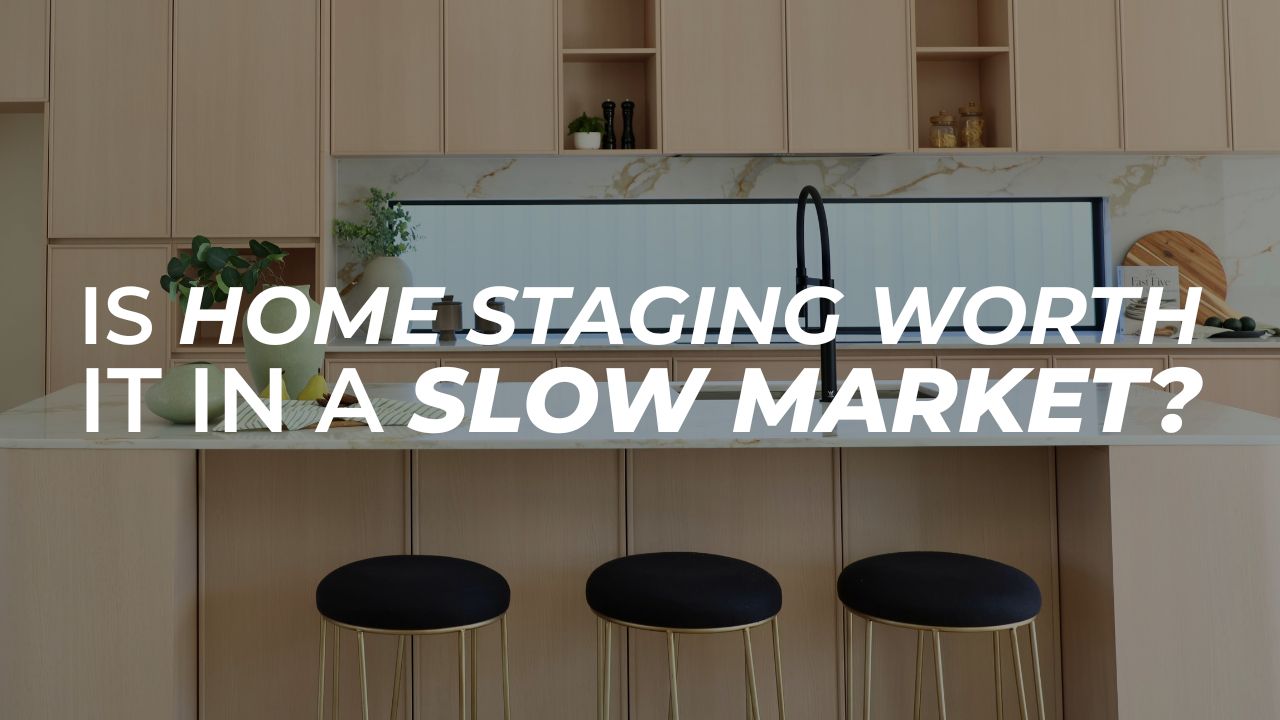
Is home staging worth it in a slow market?
“The market’s slow. Is staging a waste if my home doesn’t sell?”
It’s a fair question. Homes are taking longer to sell than they were at the start of the year, and spending money before you list feels riskier when you’re not sure how the campaign will go.
The short answer is that homes are still selling. The harder questions in a slower market are what price you’ll get, how long it takes, and whether your expectations line up with what buyers are paying right now. Styling is what gets more buyers through the door. The agent turns that interest into offers. In this market, you need both.
We’ve staged more than 8,500 homes across Brisbane and the Gold Coast. Here’s what our co-founders, Phoebe and Jake, are seeing right now, written in October 2026.
What’s happening in the market right now?
Homes are sitting on the market for longer.
“We are seeing a change in how long properties are sitting on the market,” Phoebe says. “Agents are having to work really, really hard to get those sales across the line.”
Jake’s view is that it isn’t the same everywhere. “It’s no secret that right now the property market is a little bit slower, for not everything. There’s definitely properties and areas that are selling quickly,” he says. “The prices that people want to achieve, they are still being met in certain areas, certain properties, but it’s generally taking a little bit longer to get that contract.”
He’s also honest that some values have moved. “There are going to be some properties that were at a certain value six months ago that now are probably not quite at that value, or at least that’s not what the comparable sales are suggesting.” That’s not across the board, and not every type of home in every area.
If that worries you, Jake’s advice is to talk to your agent. “That’s a legitimate reason to ask some questions of your agent. What does the market look like? What would they suggest? Because they’re going to know more about the particular property.”
Will my home still sell?
For most homes, yes. The bigger questions are price and time: what you’ll get for it, how long it takes, and whether you’ll be happy with the result.
“It’s not that the property isn’t going to sell,” Phoebe says. “It’s how can we get those buyers through, and how long is it going to take to sell.”
Price expectations are the part nobody can style around. “You can’t sell a home if the price expectations are not willing to meet the market,” Jake says. “What somebody’s willing to pay is always going to be determined by the other side of the table.”
That’s a conversation to have with your agent before you list. Ask what comparable homes have actually sold for in the last few months, not what they were listed at, and whether your price expectation sits within that.
What changes for buyers in a slower market?
There are still buyers. What’s gone is the rush.
When the market was moving quickly, buyers worried about missing out, so they put their best offer forward early. In a slower market, they don’t feel that pressure. Phoebe puts it from the buyer’s side: “There’s no fear of missing out, because we don’t have the volume of buyers that were through before. So therefore I don’t need to put this top offer over here. I might be able to hedge my bets and go see this one over here.”
That changes the job. When the market isn’t creating urgency for you, the home has to do more of it.
Where does staging fit in a slower market?
Staging’s job is to get more of the right buyers interested, and to give them a reason to remember your home over the others they saw that weekend.
Phoebe compares it to a bed retailer. The display at the front of the store is dressed for a reason. “Visual merchandising is a career because if we dress it up, people pay more. It entices people in.”
Her point isn’t that the furniture adds a set amount to the price. It’s about how many people want the home. “It’s how many people we’re going to draw in, because we’re creating a product that people actually want to see, that people are actually going to create an emotional connection with,” she says. When more than one buyer wants the same home, the urgency comes back, even when the wider market is quiet.
Jake makes a similar point from the other direction. Buyers are always comparing your home against the others on their list, and that doesn’t change with the market. This is particularly important when considering whether to sell your home vacant or staged. “Regardless of the market, whether it’s slow moving, fast moving, you’re always going to get a property that stands out better, and that should lead to a better outcome,” he says.
“The styling side of it is what gets those buyers through, and it makes it possible to have those conversations,” Phoebe says.
Is styling enough on its own?
Phoebe’s answer is no.
“Well-presented properties still sell during a market like this. You have to have the right team as well as the styling,” she says. “Right now you’re paying dividends in having a very experienced, well-seasoned agent in your corner.”
The agent’s job is to get your home in front of enough people, with strong marketing, and then to turn interest into offers. Styling gets buyers through the door. The agent has to do the rest.
Where Phoebe sees homes sitting longest is when the styling is there but the rest of the campaign isn’t. “Having styling alone with an inexperienced or brand new agent, or an agent that doesn’t believe in great photography or marketing or getting videography of the property, it’s not going to get the exposure your home needs,” she says. “Those properties are sitting for a whole lot longer.”
What should you ask your agent before you list?
In a slower market, choosing the agent matters as much as anything else you decide. Phoebe’s checklist, from someone who has worked with more than a thousand of them:
- How do they communicate? Do they turn up when they say they will, and are their emails sent and written properly? “If they have that discipline in that communication, they’re going to have the discipline in the way that they operate.”
- Have they sold homes like yours, in your suburb, recently? “Particularly in a market like this, I wouldn’t be dabbling and I wouldn’t be trying something new.”
- What does the campaign look like? Where will the home be advertised, will there be video, and how will they get people to the first open home?
- How does it feel? At some point there’ll be a hard conversation, about price or about how buyers are seeing the home. “Gut feel counts for so much more than I think most people appreciate,” she says.
If your agent is recommending staging, it’s also worth asking what they’ve seen on comparable homes in your area. In a slower market, Phoebe suggests looking past the sale price to foot traffic through the open homes and online views, and comparing homes that were styled with homes that weren’t. “It’s whether or not a sale actually happened.”
So is staging a waste of money in a slow market?
It’s a reasonable worry, and nobody can promise you a sale. What Phoebe and Jake are seeing is that well-presented homes are still selling, and that the ones sitting longest tend to be missing part of the campaign, whether that’s the presentation or the agent behind it.
In a slower market, the first few weeks matter even more. “The best buyers generally come in the first two weeks. That’s what most agents will tell you,” Jake says. If a home doesn’t get the interest it needs in that window, the next conversation with the agent is often about a price reduction, and in Jake’s experience that reduction is almost always larger than what staging would have cost at the start.
If you’re still weighing up the investment, we’ve also broken down whether home staging is worth the cost in Brisbane and the Gold Coast.
If you’re getting ready to sell, book a complimentary consultation. A Foxy stylist meets you at the property, talks through what will make the strongest impression with buyers, and you get a full quote back within 24 business hours.