

When a Home Breaks the Mould, Styling Matters Even More
Most homes we walk into are fairly predictable. Squares. Rectangles. Straight walls. You can instantly picture a sofa on one side and a dining table on the other.
But every now and then, we’re called into something completely different.
Over the years we’ve styled all sorts of homes. Today we’re talking about three in particular: a round house, a hexagon, and a full triangle home.
All architecturally impressive. All beautifully designed. And all surprisingly hard for buyers to wrap their heads around.
Here’s what those homes taught us.

The round home in Indooroopilly was art deco inspired and truly circular in almost every sense.
Round living spaces. Curved concrete walls. A circular sunken lounge. Even internal turrets.
In a property like that, you’ve got two choices. Fight the architecture or work with it.
We chose to lean in.
Curved sofas. Round coffee tables. Oval dining tables. Soft, rounded accessories. We avoided sharp lines and let the furniture echo the shape of the home rather than compete with it.
There were practical challenges too. Hanging artwork on curved concrete walls isn’t simple, so we kept it minimal and worked with existing hooks. Instead of filling every wall, we created focal points.
The home went to auction and sold for $3.4 million to a local buyer who’d been walking past with his dog.
A unique property, presented in a way that made sense.
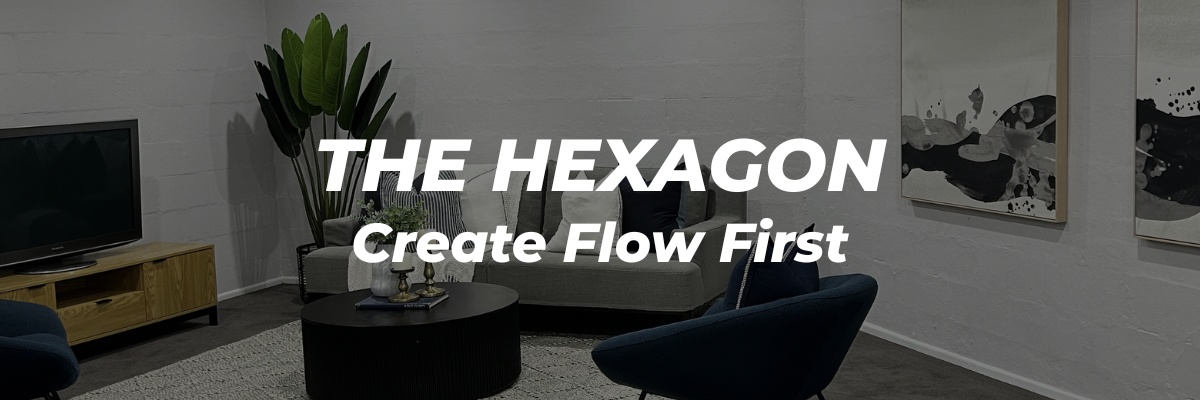
The hexagon home in Sinnamon Park was a different kind of puzzle.
Angles everywhere. Internal load bearing walls splitting the layout. Long, awkward living zones that didn’t naturally define themselves.
Instead of overcomplicating the geometry, we focused on flow and first impressions.
Light, bright furniture. Clear zoning. Sofas positioned against solid walls where possible to ground the rooms.
Upstairs was manageable. Downstairs required more thought. Even the outdoor spaces were small and triangular, which made it harder to showcase Queensland’s indoor outdoor lifestyle.
With multiple living areas, bedrooms and outdoor zones, this was a big job. But once styled, the home felt cohesive.
Without furniture, buyers would’ve struggled to see how it worked. With it, the angles became less intimidating.
Sometimes it’s not about hiding the shape. It’s about making it feel usable.
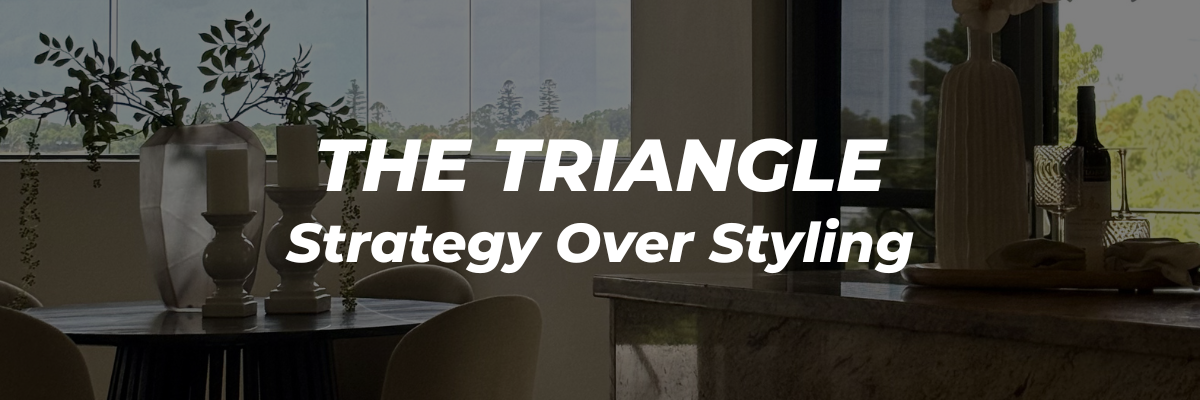
The triangle house in Ipswich was the toughest of the three.
Every room was triangular. The footprint. The pool. The layout.
This one was constant problem solving.
We prepared multiple layout options. Used glass top dining tables to keep things visually lighter. Brought flexible pieces we could swap in and out on install day.
There were practical constraints too. No built in robes in some rooms. Narrow walkways. Coffee tables that had to be removed because they blocked access to outdoor areas.
Interestingly, triangle was the hardest shape to style. Hexagon sat somewhere in the middle. Round was surprisingly manageable because curved furniture is on trend right now.
But the bigger issue wasn’t just logistics.
Shapes like triangles can be polarising. Some buyers simply can’t visualise themselves living in them. In certain markets, that can shrink your buyer pool fast.
That’s exactly why presentation matters.
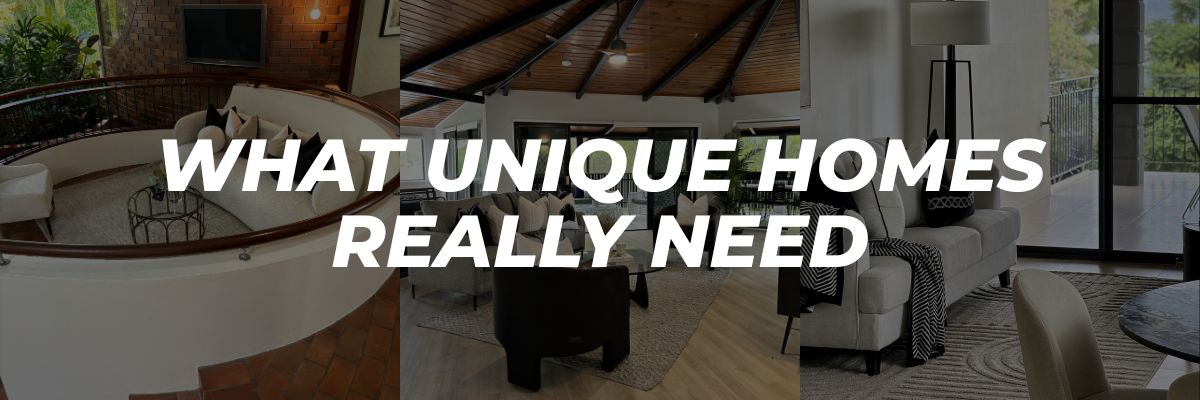
All three homes were architecturally designed and genuinely impressive.
But they were also polarising.
Not everyone instantly “gets” a round house or a triangular floor plan. And when buyers feel confused, they hesitate.
Our role isn’t just to make a home look good. It’s to reduce friction. To answer the silent question of “But where would my couch go?”
When a property sits outside the norm, that clarity becomes even more important.
Sometimes the most beautiful homes are also the hardest to visualise. And those are the ones that benefit most from thoughtful, strategic presentation.
If you’re selling a unique property, or working with one that’s been sitting because buyers can’t quite figure it out, it might not be the architecture that’s the issue.
It might just be the way it’s being shown.


Facebook Comments